What Horses Teach Us About Our Nervous System


There is a particular kind of reverence and honesty that exists in the presence of a horse. It is quiet, strong, and impossible to negotiate with. You can enter an arena or pasture believing you are calm, composed, and fully in control, and within moments, a horse may reveal something different.
Not through words, but through distance or closeness, movement or stillness.
As prey animals, a horse's survival depends on reading subtle, nonverbal cues in their environment. They notice changes in breath, muscle tension, posture, and intention long before we are consciously aware of them ourselves. When we step into their space, they are not evaluating our stories; they are attuning to our state of being. That attunement is what makes equine-assisted therapy such a powerful teacher.
Beginning from the Bottom Up
Much of traditional self-reflection begins with thoughts:
Why did I react that way? What does this mean about me? How do I fix it?
But trauma and chronic stress are not primarily cognitive experiences. They are physiological ones. The body reacts first, and the story follows.
Equine work approaches healing from the bottom up. Instead of starting with analysis, it begins with sensation.
What is happening in your chest as the horse approaches? Where do you feel tightness when the horse turns away? What shifts when you stop trying to perform calmness and simply breathe?
Because horses are highly sensitive to regulation and dysregulation, they often act as co-regulators. A horse that feels grounded presents a steady breath, a relaxed stance, and rhythmic movement, and can influence the human nervous system in subtle yet meaningful ways.
Clients frequently describe feeling unexpectedly peaceful in the presence of a horse, even when anxiety has followed them everywhere else. That peace is not imaginary; it is relational. The body senses safety and begins to recalibrate.
Horses as Emotional Mirrors
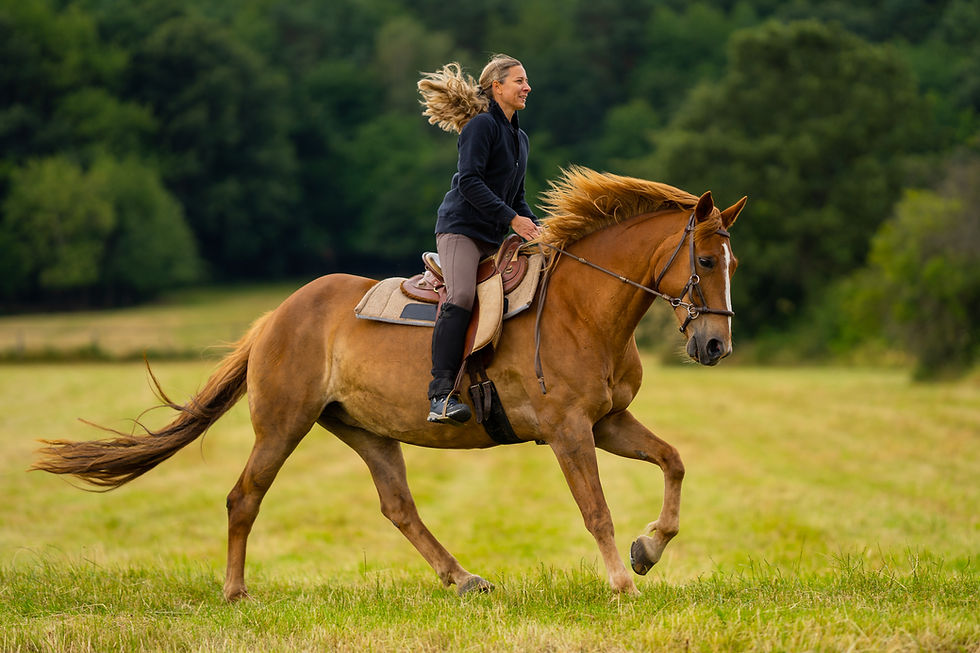
One of the most profound aspects of equine-assisted sessions is the way horses reflect emotional states without criticism or bias. If a person approaches with guarded energy, the horse may hesitate. If that same person softens even slightly, the horse often responds.
The feedback is immediate and embodied in a beautiful relationship between this regal animal and a human companion.
Nothing is being diagnosed or judged in those moments. Instead, the horse's response becomes information. It offers insight into what is happening beneath conscious awareness and invites curiosity rather than shame. The relationship shifts as the person shifts. And that lived experience can be far more transformative than intellectual understanding alone.
Herd Energy and Human Connection

Horses are herd animals, which means their survival depends on connection and attunement. In a healthy herd, members remain aware of one another's needs. When one is injured or distressed, others adjust their behavior. Safety is collective.
This dynamic offers a powerful metaphor for human nervous systems. We are wired for co-regulation, even if cultural messages have encouraged hyper-independence. Many of us have learned to function like isolated pack members, self-reliant, guarded, and responsible only for ourselves. Yet our physiology tells a different story. We regulate best in the presence of a steady, responsive connection.
Observing herd behavior can challenge the belief that healing must be solitary. Horses remind us that regulation and resilience are strengthened in relationships. Then, in the arena, stillness carries powerful meaning. A horse that pauses is not necessarily resisting; they may be assessing. A horse listens to its environment before moving forward. That pause is the animal collecting data.
For humans who equate stillness with avoidance or failure, this can be a profound reframe. When working with horses, clients often discover that slowing down reveals more than pushing ahead. A moment of quiet beside a horse can illuminate tension patterns, emotional habits, or protective strategies that were previously invisible. Stillness becomes an invitation to listen rather than a sign that something is wrong.
Movement, Curiosity, and Beginning Again
Horses are naturally curious. They approach, retreat, and circle back. Their movement is responsive rather than forced. This quality aligns beautifully with the symbolism associated with the Year of the Horse: forward motion, fresh starts, and the energy of a new chapter.
But horses teach us that forward movement is most sustainable when it emerges from regulation. It is not frantic or performative, rather aligned where curiosity replaces urgency, and presence replaces pressure. In this way, beginning again is not about dramatic reinvention. It is about moving from a steadier place within.
Sound, Resonance, and the Body
Some equine practices, like the events we host at Stable Minds, incorporate sound healing alongside horse work, recognizing that vibration and rhythm also speak directly to the nervous system. Sound bypasses analysis in much the same way horses do. When steady equine presence and resonant sound converge, clients often experience a deepened sense of grounding. The body softens before the mind fully understands why.
This is not mystical as much as it is physiological. Regulation can be facilitated through relationship, rhythm, and safe sensory input.
Carrying the Lessons Forward
Even for those who may never participate in equine-assisted therapy, the lessons horses offer are accessible in daily life.
Notice your breath before you respond in conflict.
Pay attention to muscle tension before you explain it away.
Seek relationships and environments that help your body soften rather than brace.
Allow pauses to inform you rather than alarm you.
Horses teach us that our nervous systems are always communicating. Healing does not begin with perfectly chosen words; it begins with awareness of what is happening beneath them. When we learn to read our own bodies with the same sensitivity that horses use to read us, we move through the world with greater steadiness.
And from that steadiness, genuine forward movement becomes possible.
About the Author:

Angel Ianakiev, LCSW, CADC, PMH-C
Anchor Counseling and Stable Minds in Geneva and Elburn, Illinois
After two decades away from riding, Angel leased a retired camp horse named Lee for a summer. What she expected to be a familiar pastime became something powerfully restorative. The dusty aisles combined with the rhythmic sound of hooves shifting in the stall gave Angel a grounded presence that allowed her nervous system to soothe and settle.
“It became this pocket of stillness,” explained Angel. “A place where my mind could slow down.”
Over time, Angel began to recognize that what she was experiencing wasn’t just personal; it was therapeutic. Horses offer something traditional therapy rooms sometimes cannot: embodied feedback. They respond to breath, posture, tension, and emotion before those experiences ever reach language. Horses mirror what we carry internally, without judgment or agenda.
Today, equine-assisted psychotherapy is one of the most distinctive offerings at Angel’s practice, Anchor Counseling. In the arena, healing unfolds through relationship and awareness. Clients don’t have to explain everything. The work happens in real time, through connection and regulation with subtle shifts the body understands before the mind does.
For more information about therapy with Angel and Stable Minds, visit anchorcounseling.org


Comments